

Who UniMate is for#
Prototyping creature animation
Generate rough walk, fly or swim motion for a non-human rig from a short prompt, to block out a scene before committing to hand animation.
Skip if:
You need production-ready, hand-polished animation with guaranteed quality on a specific rig.
Animation research and benchmarking
Use the code, checkpoints and UniML3D dataset as a baseline for work on cross-topology motion generation.
Skip if:
You do not have a GPU environment or the time to set up a research codebase.
The problem it solves#
Rigging has become fast, but animating the result has not. Learned animators usually depend on category-specific templates, per-skeleton fine-tuning, or reference motions at inference. Teams working with varied characters, creatures and rigid objects either buy fixed motion packs or hand-animate each rig. UniMate targets that gap: given any rigged asset and a text prompt, it synthesizes motion for that exact skeleton, with no test-time optimization.
How it solves it#
One model for diverse skeletons
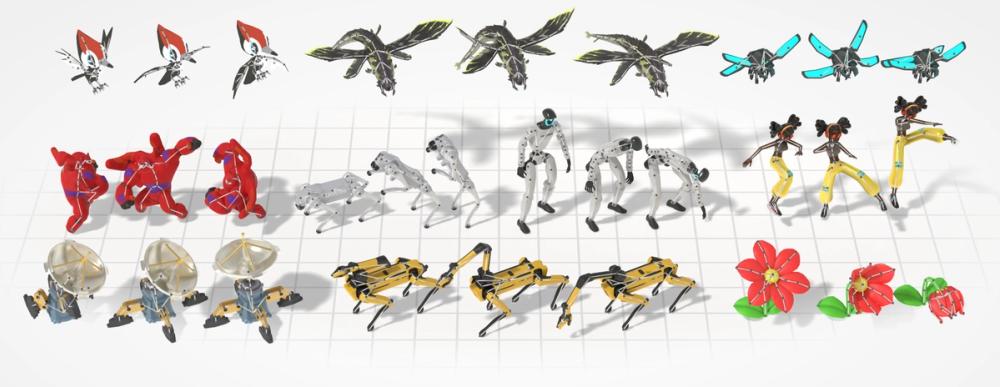
A topology-aware diffusion transformer adapts to each rig's structure, covering bipedal, quadrupedal, avian, marine, insectoid, serpentine and articulated rigid objects without retraining per skeleton.
Text-prompted motion generation
Provide a rigged 3D asset and a prompt such as a dog walking or a dragon taking off. The model generates motion for that skeleton and exports sample renders and motion files.
Zero-shot editing, in-betweening and expansion
The same trained model keeps chosen joints or keyframes fixed and regenerates the rest, or chains several prompts into a longer motion, with no fine-tuning or auxiliary networks.
UniML3D dataset and training code
The repo includes training configs, inference scripts and a data-processing pipeline. UniML3D holds 13,006 text-paired motion sequences, released on Hugging Face.
Animated mesh export
A helper script turns generated motion files into an animated GLB and FBX for the original rigged mesh, so results can move into a standard 3D workflow.
Strengths and trade-offs#
Strengths
- Topology generalizationOne set of weights handles very different skeletons, so you do not need a separate model or fine-tuning run for each creature or object rig.
- Open code, weights and dataTraining and inference code is MIT licensed, preview checkpoints are on Hugging Face, and the processed dataset and its pipeline are published.
- Several tasks from one modelEditing, in-betweening and motion expansion reuse the pretrained model by holding parts of the motion fixed during sampling.
Trade-offs
- -Early research releaseThe README calls UniMate an early step toward text-to-animation for any skeleton and says many motions and skeletons still fail. Expect rough results on unusual rigs.
- -Setup and hardware demandsYou install a conda environment and run Python scripts, and sampling expects the training dataset features for the target skeleton to be present. A GPU is practical for any serious use.
- -Data licensing gapsThe Truebones ZOO motions are a commercial asset pack that cannot be redistributed, so you must buy that pack yourself to rebuild the full dataset. An official preprocessing pipeline for new rigs was still listed as a TODO.
UniMate vs alternatives#
UniMate vs Truebones ZOO motion packs
Truebones ZOO is a commercial pack of animal motion clips. The UniMate authors consume it as part of their training data and note that its license does not permit redistribution. A pack gives you fixed, authored clips for a fixed set of creatures. UniMate generates new motion from a prompt for the rig you supply, including rigs outside any pack, but quality varies and the project says many motions still fail.
UniMate vs Mixamo
Mixamo is a proprietary service with a library of human animations, and the UniMate dataset draws on Mixamo clips. Its strength is a large catalog of human motion. UniMate targets the case Mixamo's human focus does not cover: arbitrary skeletons such as quadrupeds, birds, insects and snakes, driven by text. You trade a polished hosted service for a self-run research codebase.
Where the open model fits
UniMate suits teams that want to prototype motion for varied rigs, or researchers who need open weights, code and data. It is not a drop-in replacement for a polished commercial animation suite. Expect to run Python, manage a GPU environment and review generated clips before they reach a project.
Quick start#
Setup uses a conda environment with Python 3.10 and the repository's requirements file.

```bash
git clone https://github.com/Friedrich-M/UniMate.git
cd UniMate
conda create -n unimate python=3.10 -y
conda activate unimate
pip install "setuptools<81"
pip install -r requirements.txt --no-build-isolation
```What it's built on#
- Languages
- Python
FAQ#
What does UniMate do?
It generates articulated motion for a rigged 3D asset from a text prompt. A single unified model handles many skeleton types, with no per-skeleton retraining and no test-time optimization.
What license is UniMate under?
The repository is MIT licensed. The Truebones ZOO motions used to build part of the dataset are a separate commercial pack that is not redistributed, so you must purchase it directly to reproduce that portion.
Can I use it for editing or in-betweening existing motion?
Yes. The same pretrained model supports motion editing, in-betweening and expansion by pinning chosen joints or keyframes during sampling, with no fine-tuning.
Is it production ready?
Not yet. The authors describe it as an early step and note that many motions and skeletons still fail. Preview checkpoints are on Hugging Face and new ones will be synced there.
Similar open-source tools#

God's Eye View
Real-time global intelligence on a 3D globe

Firebase Ios Sdk
Open source Apple SDK for Firebase auth, data, push and crashes

servers
Open reference servers for connecting AI to external tools and data

openGym
Self-hosted gym tracker with no subscription or telemetry

vscode
Open source AI code editor for multi-agent development

univer
Embed spreadsheets, docs, and slides in your own product