Open Source Alternatives
  • Alternatives
  • Categories
    Categories by size1,302 projects
    • Developer Tools673
    • AI & Machine Learning549
    • Business & Productivity311
    • Web Development219
    • Security & Monitoring198
    • Communication & Collaboration168
    • IT Management165
    • Design & Creative145
    • LLMOps & AI Tooling142
    • DevOps & CI/CD141
    Browse all 21 categoriesCloud & Hosting, Product & Project Management and 9 more
  • Blog
  • Advertise
SearchNotion, Slack, password manager.../
Submit
Open Source Alternatives
  • Alternatives
    • Developer Tools673
    • AI & Machine Learning549
    • Business & Productivity311
    • Web Development219
    • Security & Monitoring198
    • Communication & Collaboration168
    • Browse all 21 categories
  • Blog
  • Advertise
Submit your project

New open source projects by email

The projects we add and every new guide. Free, unsubscribe any time.

Open Source Alternatives LogoOpen Source Alternatives

Handpicked Open Source Alternatives to Paid Softwares

Add Open Source Alternatives as a preferred source on Google

Product

  • Categories
  • Tag
  • Advertise

Resources

  • Blog
  • Collection
  • Submit

Company

  • Privacy Policy
  • Terms of Service
  • Refund Policy
  • Sitemap

Alternatives

  • Claude Code
  • Jira
  • Notion
  • Slack
  • Linear
  • Wispr Flow
  • All alternatives
© 2026 Open Source Alternatives. All rights reserved.
Open SourceAlternatives
Home/Categories/Developer Tools/Pullboard
icon of Pullboard

Pullboard

  • 846 stars
  • MIT
  • Active this week
  • Last commit 2 days ago

Last verified Nov 18, 2026

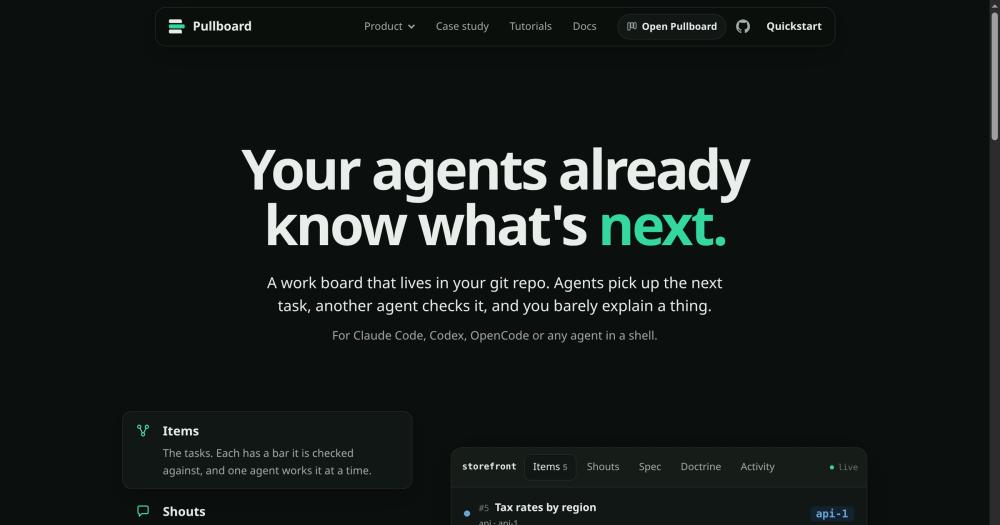
Orchestrate autonomous AI agents in a git-native work board where a second agent verifies every change before it merges to main.

Visit websiteGitHub846 starsDeploy on Hostinger
image of Pullboard
TL;DR

Pullboard is a git-native work board for running multiple AI coding agents on the same codebase. When a builder agent submits work, a different agent checks that exact commit against the frozen requirement before anything reaches main. MIT licensed, local-first, and compatible with Claude Code, Codex, OpenCode, or any agent in a shell. Best for developers and small teams who want to run agents in parallel overnight without watching every step.

Read the full breakdownHide the full breakdownWho it is for, how it works, trade-offs, the quick start and the FAQ
who it's for

Who Pullboard is for#

Teams running multiple AI agents in parallel

When several builders work in parallel lanes, Pullboard keeps them out of each other's way with atomic claims and isolated worktrees. Each agent picks up its next unclaimed task from the board; the verifier queue runs in parallel with building, so completed items do not wait.

Skip if:

You are running a single agent on a contained project with no need for parallel builds and no overnight autonomous builds.

Solo developers building autonomously overnight

Set up your spec and doctrine once, pair your phone, and let agents build while you sleep. Only decisions that need you come through; a coordinator agent settles the rest. You come back to shipped features with a full receipt history of what was rejected and why.

Skip if:

You prefer reviewing every agent change manually before it merges, or your project has only three to five items to build at a time.

Projects with complex, interdependent requirements

Spec rows can gate on other rows (item #6 waits on #2), and the frozen spec means every agent working on a downstream item knows exactly what the upstream requirement says. Changes to the spec surface as a new approval before any agent picks up work that depends on the changed row.

Skip if:

Your project has fewer than ten requirements and they are all independent. A simple task list works fine for projects at that scale.

Developers coordinating agents across multiple machines

With Pullboard's runner system, builders and verifiers can run on any machine that holds the board key. A developer working from a laptop can have a desktop or home server act as the runner, keeping build queues short without overloading the primary dev machine.

Skip if:

You have a single development machine and all your agents run on it. The local-only setup (the default) handles this without runners.

the problem

The problem it solves#

Running multiple AI coding agents on the same codebase breaks down without coordination. Without a shared plan, two agents touch the same file; one agent's submitted work turns out to have an edge case nobody checked; and the decision you made two sessions ago is gone when the next agent starts fresh. The agent that wrote the feature is usually the same one that declared it finished, with no independent check on whether the requirement was actually met.

The deeper challenge is coherence over time. A product's constraints, prior decisions, and design choices are spread across chat logs that end. Each new agent session starts without them. When you add more agents in parallel, the probability of a conflict or a rework grows with the count.

how Pullboard solves it

How it solves it#

Spec-driven task management

SPEC.md holds every requirement as a versioned row in a fixed format: an id, status, priority, what must be true, and the gate that proves it. Only rows you approve count; an agent claiming an item gets the exact spec text frozen at the moment of claim, so the bar cannot shift mid-build.

Isolated worktrees per agent lane

Each agent works in its own git worktree with its own branch. Claims are atomic: two agents cannot hold the same item simultaneously. Items can wait on other items (item #6 waits on #2), and the dependency is enforced before any claim is accepted.

Mandatory second-agent verification

No change reaches main without a different agent checking it. The verifier reviews the exact commit the builder submitted, against the criterion frozen when the item was claimed. Between 4 and 16 October 2026 on Pullboard's own board, 227 of 908 agent submissions were rejected and sent back; 588 items merged, none without a verifier accept.

Filtered escalation via Shouts

Agents ask questions through a named chain: a coordinator settles what it can, and only decisions that need you reach you. Shout threads are tied to their items, so context never gets lost in a side channel. Questions include code references and evidence, keeping your decisions specific rather than abstract.

Doctrine enforcement via git hooks

DOCTRINE.md holds the team's rules, each one paired with its enforcer: a git hook, a commit-msg check, or a review requirement. Hooks run automatically at commit time and block changes that break a rule. This keeps the rules in the codebase, versioned, and running without you remembering to enforce them.

Built-in local project dashboard

A local web UI shows every project on the machine on one page. Rulings (decisions only you can make) appear along the top. Work, shouts, roadmap, activity, cost, and pipeline data are tabs. pullboard view --export writes a static, replayable snapshot for sharing or auditing.

strengths · trade-offs

Strengths and trade-offs#

Strengths

  • MIT license, no account requiredPullboard is MIT licensed and stores everything in your git repository. npm install -g pullboard is the entire install; nothing phones home and no data leaves your machine. You can inspect, fork, and extend the board itself without restriction.
  • Track record on its own codebasePullboard builds itself using its own board, and the stats are public at pullboard.dev/live. Between 4 and 16 October 2026, 1 in 4 agent submissions (227 of 908) was rejected by the verifier and sent back; 588 items merged, none without a verifier accept. That rejection rate is a live demonstration of the system working as designed.
  • Works with any shell-based agentClaude Code gets a skill set, Codex reads AGENTS.md, OpenCode and others read pullboard prompt to get their first instructions. The MCP server is also available. There is no proprietary runtime: bring the agent you already trust and Pullboard adds coordination on top.
  • Network runners for parallel buildsAdd machines to the board with two commands (pullboard serve and pullboard runner serve). Each runner pulls jobs independently, runs the gate, and posts a signed receipt. pullboard stats runners shows wait times, run times, and health per machine, keeping your dev box from overloading when many agents build in parallel.

Trade-offs

  • -Node 22.13 or newer requiredThe README states Node 22.13 as the minimum. Projects on older Node runtimes need to upgrade before Pullboard will run. This may conflict with CI pipelines or other tooling pinned to an earlier version.
  • -Early version under active developmentVersion 0.9.4 at time of writing, with the last push on 2026-11-15. The project is under active development and CLI interfaces may change between releases. The upgrade path is straightforward (npm install -g pullboard), but keep an eye on the changelog when updating agents that depend on specific command flags.
  • -Coordination overhead for solo, simple projectsThe claim, verify, and lane system adds steps that may not be needed for a solo developer working on a simple project with one agent. If you need one agent to make one change and merge it, the board's structure is more than the task requires. The overhead pays off at multiple agents or longer-running projects.
versus alternatives

Pullboard vs alternatives#

Cloud AI Development Services

The closest commercial alternative to Pullboard is a managed cloud AI development service like Devin (by Cognition), where you describe what to build and the vendor's agents do the work in a closed cloud environment. Both aim at autonomous software development, but they serve different deployment models.

FeaturePullboardManaged AI Dev Services
LicenseMITProprietary
Self-hostingYesNo
Agent choiceAny shell-based agentVendor-provided only
Spec locationYour SPEC.md in gitVendor's managed interface
Independent verificationYes, mandatoryVaries
Data ownershipYour git repositoryVendor's servers

Pullboard is the better choice when you want to work with agents you already trust, keep your requirements and decision history in your own git repository, run builds on your own hardware overnight, and have full visibility into what every agent did and why a change was rejected. The MIT license means you can inspect, fork, and extend it without restriction.

A fully managed cloud AI development service fits when you want no infrastructure to maintain, have no preference for a specific underlying agent, or are running a proof of concept where the overhead of spec-driven development is not warranted.

install · quick start

Quick start#

bash
Pullboard installs as a global npm package; Node 22.13 or newer is required.
```bash
npm install -g pullboard
pullboard init
```
tech stack · detected from GitHub

What it's built on#

Languages
JavaScript
frequently asked

FAQ#

Which AI coding agents does Pullboard support?

Pullboard works with any agent that runs in a shell. Claude Code gets a Pullboard skill set, Codex reads AGENTS.md, and any other agent can call pullboard prompt with a role name to get its first instructions. The MCP server is also available for agents that support MCP. You are not locked to a specific agent or provider.

Is Pullboard free to use?

Yes. Pullboard is MIT licensed and the npm package is free. It runs entirely on your own hardware with no account required, no cloud service, and no per-seat pricing. The only cost is the AI API tokens your agents consume, billed directly by whatever provider you use.

How does the verification step work?

When a builder agent submits an item, Pullboard runs the item's gate (a test, a script, or any command you specify) against the submitted commit. If the gate passes, a second agent (the verifier) reviews that exact commit against the criterion that was frozen at claim time. The verifier either accepts the item, sending it to landing on main with a signed receipt, or rejects it with a reason the builder receives on its next claim.

Does Pullboard require a server or cloud account?

No. Everything runs locally by default. pullboard serve shares the board over your local network so other machines can join as runners, but no traffic leaves your network unless you choose to use pullboard.dev for access from your phone or a remote machine. Your git repository is the persistence layer; there is no external database.

What happens if an agent crashes or restarts mid-task?

The item stays claimed. pullboard resume returns the agent to its current claim with its work so far. If the agent does not resume, a stale-claim sentinel (configurable) can release the claim automatically so another agent can pick it up. The activity log records every state transition, so the full history of what happened is preserved regardless of how the agent exited.

also worth a look

Similar open-source tools#

rakazo

Featured

Alternative toGrok Bot

AI teammates you own: your keys, your model, your machine.

  • 8,913 GitHub stars
  • Apache-2.0Licence Apache-2.0

Qualitylayer

Alternative toDevin

Structured plan-build-review workflow for coding agents.

  • 2,149 GitHub stars
  • CustomLicence Proprietary (subscription required, source-available)

Commonly

InCommunication & Collaboration

Bring your AI agents into one shared team workspace, self-hosted.

  • 1,405 GitHub stars
  • Apache-2.0Licence Apache-2.0

Dev 3.0

Alternative toConductor

Kanban board where every card is a live AI agent in its own worktree.

  • 334 GitHub stars
  • Apache-2.0Licence Apache-2.0

Agent Teams AI

Alternative toConductor

AI agent teams with a Kanban board, code review, and 300+ models.

  • 2,504 GitHub stars
  • AGPL-3.0Licence AGPL-3.0

Agentbox

Alternative toConductor

Desktop inbox for parallel Claude Code and Codex agents

  • 432 GitHub stars
  • GPL-3.0Licence GPL-3.0
by category

Open source tools in these categories#

673

Developer Tools

REA (Reverse Engineer Anything), Skills for Real Engineers, superpowers
127

Product & Project Management

freeCodeCamp, agency-agents, Gstack
549

AI & Machine Learning

OpenClaw, REA (Reverse Engineer Anything), freeCodeCamp
Hostinger

Self-host Pullboard on a Hostinger VPS

Keep it running 24/7, even when your laptop is off. A Hostinger VPS gives it a server of its own.

  1. 01

    Choose a plan

    Starts from $6.49/mo

  2. 02

    Apply

    Extra 10% off yearly plans

  3. 03

    Install Pullboard

    On a server that stays on

  4. 04

    Start building

    Focus on the app, not the server

Deploy on Hostinger

Sponsors

Inbox Zero

Alternative toSuperhuman

AI email assistant that drafts replies and clears your inbox

  • 13,058 GitHub stars
  • AGPL-3.0Licence AGPL-3.0
  • #Email

rakazo

Alternative toGrok Bot

AI teammates you own: your keys, your model, your machine.

  • 8,913 GitHub stars
  • Apache-2.0Licence Apache-2.0
  • #AI Agents

SnitchFeed

Live monitoring on LinkedIn, X, Reddit & more. Agentic social listening for startups.

Marketing & Growth

Advertise your product

New open source projects by email

The projects we add and every new guide. Free, unsubscribe any time.

Find open source alternatives to paid software

/
  • Claude Code to OpenCode
  • Jira to Windshift
  • Notion to AppFlowy
  • Slack to Mattermost
  • Linear to GitLab
  • Wispr Flow to Handy
  • Arc to Zen Browser
  • CapCut to Concat
  • Grok Bot to rakazo
  • Superhuman to Inbox Zero
  • Discord to Stoat
  • Airtable to AITable
  • Datadog to SigNoz
  • Muse to OpenClaw
  • Railway to Coolify
  • GitHub Copilot to Cline
  • Confluence to Wiki.js
  • Microsoft Teams to Rocket.Chat
  • 1Password to KeePassXC
  • Firebase to Supabase
  • Pinecone to Qdrant
  • Zapier to n8n
  • Devin AI to OpenHands
  • Asana to Leantime