Open Source Alternatives
  • Alternatives
  • Categories
    Categories by size1,263 projects
    • Developer Tools650
    • AI & Machine Learning535
    • Business & Productivity305
    • Web Development217
    • Security & Monitoring196
    • Communication & Collaboration168
    • IT Management160
    • Design & Creative138
    • DevOps & CI/CD135
    • LLMOps & AI Tooling135
    Browse all 21 categoriesCloud & Hosting, Product & Project Management and 9 more
  • Blog
  • Advertise
SearchNotion, Slack, password manager.../
Submit
Open Source Alternatives
  • Alternatives
    • Developer Tools650
    • AI & Machine Learning535
    • Business & Productivity305
    • Web Development217
    • Security & Monitoring196
    • Communication & Collaboration168
    • Browse all 21 categories
  • Blog
  • Advertise
Submit your project

New open source projects by email

The projects we add and every new guide. Free, unsubscribe any time.

Open Source Alternatives LogoOpen Source Alternatives

Handpicked Open Source Alternatives to Paid Softwares

Add Open Source Alternatives as a preferred source on Google

Product

  • Categories
  • Tag
  • Advertise

Resources

  • Blog
  • Collection
  • Submit

Company

  • Privacy Policy
  • Terms of Service
  • Refund Policy
  • Sitemap

Alternatives

  • Claude Code
  • Jira
  • Notion
  • Slack
  • Linear
  • Wispr Flow
  • All alternatives
© 2026 Open Source Alternatives. All rights reserved.
Open SourceAlternatives
Home/Categories/Security & Monitoring/Telltaledns
icon of Telltaledns

Telltaledns

Open source alternative to NextDNS, Control D and AdGuard DNS

  • 214 stars
  • Apache-2.0
  • Active this week
  • Last commit today

Last verified Nov 15, 2026

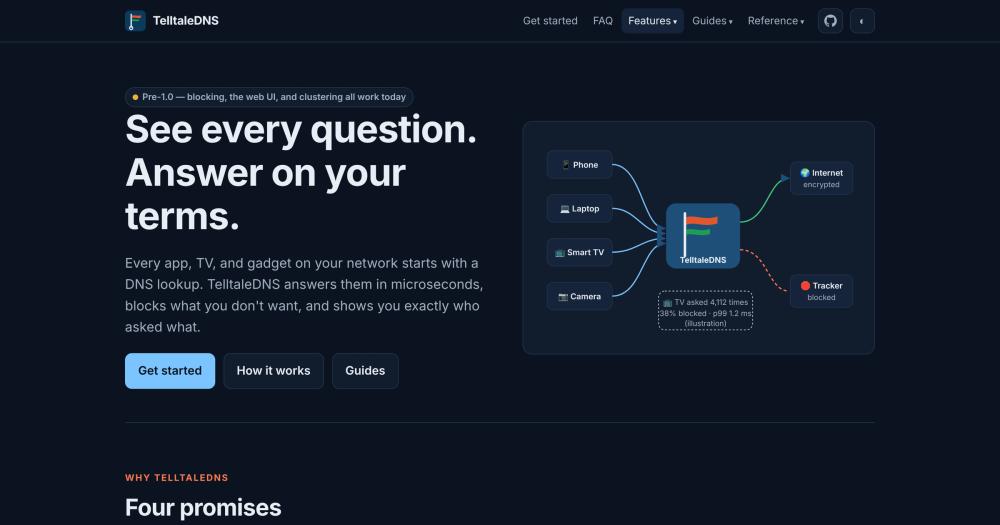
Run a self-hosted DNS resolver that blocks ads, encrypts lookups, and ties every query to the device that asked it, with an explained log.

Visit websiteGitHub214 starsDeploy on Hostinger
Image for Telltaledns
TL;DR

Telltaledns is a self-hosted DNS resolver that blocks ads, encrypts lookups, and ties every query to the device that asked it. Each log entry shows the device name, the per-stage timing, and the reason it was blocked or allowed down to the specific list and line. It runs under Apache-2.0 OR MIT on a Raspberry Pi, in Docker, or in Kubernetes. For homelab operators and privacy-focused households wanting per-device DNS policy without sending query logs to a cloud provider, it replaces paid services like NextDNS and AdGuard DNS while keeping all traffic on-network.

Read the full breakdownHide the full breakdownWho it is for, how it works, trade-offs, the quick start and the FAQ
who it's for

Who Telltaledns is for#

Homelab operators replacing cloud DNS filtering

TelltaleDNS runs on a Raspberry Pi with Docker Compose and replaces the router's upstream DNS. Per-device rules mean the work laptop can use different blocklists than smart TVs. The web UI shows every query with its explanation, so diagnosing why an app broke after a rule change takes seconds.

Skip if:

You need a managed service with no server to maintain. NextDNS and Control D handle DNS filtering with no hardware beyond a router setting.

DevOps teams securing Kubernetes workload DNS

TelltaleDNS names Kubernetes pods by their workload identity in the query log, so a misconfigured service making unexpected outbound calls appears with its pod name. The Helm chart deploys into an existing cluster with one persistent IP for DNS and the web UI.

Skip if:

Your cluster DNS is handled by a service mesh or cloud provider DNS with built-in observability, and you do not need per-pod visibility at the query level.

Privacy-focused households with multiple device types

TelltaleDNS recognizes device types (Roku players, cameras, thermostats) from the maker prefix and DNS patterns, and suggests names and groups. Children's devices can get a different upstream with safe search enforced; IoT devices can be isolated to their own group with stricter blocking.

Skip if:

You have only one or two devices and no need for per-device policy. A simple Pi-hole setup covers ad blocking at that scale with less configuration.

the problem

The problem it solves#

Cloud DNS filtering services like NextDNS, Control D, and AdGuard DNS make network-wide ad blocking easy, but they come with a tradeoff: your devices' query logs travel to and are stored on someone else's infrastructure. For households and teams with strict privacy requirements, that sends the very metadata those services promise to protect somewhere outside your control.

Even when privacy is acceptable, the visibility these services offer is limited. They report per-account aggregate stats. If one device on your network is making unusual queries, or if you want different blocking rules for a work laptop, a smart TV, and a child's tablet, cloud DNS services either lack per-device policy at that granularity or charge more for it. Setting up those policies and understanding why a specific query was blocked or allowed requires digging through vendor-specific dashboards, not an open log on your own machine.

how Telltaledns solves it

How it solves it#

Per-device query log with explained answers

Every query in the log is tied to a named device, timed per stage (listener, cache, filter, upstream, response), and annotated with why it was blocked or allowed, down to the specific blocklist and line. The explanation is on every row, not just on blocked entries.

Per-device and per-group blocking rules

Each device or VLAN gets its own blocklists, service-blocking categories, schedules, safe search setting, and upstream servers. Changes can be previewed against yesterday's real traffic before saving, so you can see the effect without a live rollout.

Encrypted DNS both ways

Supports DoT, DoH, and DoQ to your devices and to your upstreams, plus DNSSEC validation. Full recursion is available for setups that prefer not to forward queries at all. All three encrypted protocols work as both listener types and upstream targets.

Pi-to-Kubernetes clustering

A single binary artifact runs on a Raspberry Pi, in Docker, and in Kubernetes. The same config and management plane spans all three. A Helm chart deploys resolver pods with one persistent IP, and a Pi can join as a second server for DNS failover.

Small footprint with low RAM usage

The binary image is about 13 MiB; the resolver idles at about 14 MiB of RAM. With 2.7 million blocked names loaded, it uses about 50 MB on a Raspberry Pi 4. Cached and blocked answers arrive within 250 microseconds of the query at load, measured from another machine.

Prometheus metrics and Grafana dashboard

Exposes Prometheus metrics out of the box, with a prebuilt Grafana dashboard included in the repository. No separate instrumentation is required to get query counts, latency, block rates, and device-level stats into Grafana.

strengths · trade-offs

Strengths and trade-offs#

Strengths

  • Query logs stay on your own networkNextDNS and AdGuard DNS store query history on their servers. TelltaleDNS keeps every log entry on your own machine, so no query metadata leaves the network; the entire history is yours to query, export, or delete at any time.
  • Apache-2.0 OR MIT dual licenseLicensed under Apache-2.0 OR MIT at the user's option, both OSI-approved permissive licenses. You can run it internally for a business, modify it, and redistribute it without restriction. No fees, no usage limits, no call-home requirement.
  • Same artifact from Raspberry Pi to KubernetesThe same static binary runs on a Raspberry Pi, in Docker on a Linux host, and in a Kubernetes cluster, managed as one system from a single control plane. A team that starts on a Pi can grow into Kubernetes without migrating configs or switching tools.
  • Pi-hole and Technitium importReads Pi-hole's blocklist formats, regex rules, and Teleporter exports without conversion. Also reads the Technitium DNS Server API to import an existing configuration. Teams migrating from either tool can bring their rules across without rewriting them.

Trade-offs

  • -Pre-1.0 status means configuration and APIs can changeTelltaleDNS is pre-1.0. Configuration keys and APIs are documented as subject to change before 1.0, with each pre-release noting every breaking change. For production networks that cannot absorb breaking changes without notice, this is a real consideration until the 1.0 release ships.
  • -Self-hosting adds infrastructure managementUnlike NextDNS or Control D, TelltaleDNS requires a host you manage: a Raspberry Pi, a Linux server, or a Kubernetes cluster. You are responsible for uptime, updates, and backup. The serve-stale and failover features reduce the impact of outages, but they do not eliminate the operational burden.
  • -New project with a small contributor baseTelltaleDNS was created in October 2026 and has 218 GitHub stars and 3 open issues. The contributor list in the README names two contributors. For teams that require a mature community, long-term commit history, or guaranteed support paths, this is a newer project than established alternatives like Pi-hole or Technitium.
versus alternatives

Telltaledns vs alternatives#

TelltaleDNS vs NextDNS

NextDNS is a cloud DNS filtering service that blocks ads and trackers across all devices on an account. Both tools provide per-device rules and encrypted DNS, but they diverge on where query logs are stored.

FeatureTelltaleDNSNextDNS
HostingSelf-hostedCloud managed
LicenseApache-2.0 OR MITProprietary
Query logOn your serverNextDNS servers
Kubernetes supportYes (Helm chart)No
PricingFree (self-hosted)Paid service

TelltaleDNS is the better fit when query logs staying on your network is a requirement, when you want per-entry explanations showing exactly why each query was blocked or allowed, or when you need DNS policy in a Kubernetes cluster. NextDNS is the better fit when you want managed filtering with no server to maintain and prefer a service with years of track record.

TelltaleDNS vs Control D

Control D is a paid DNS service with per-device filtering, custom redirect rules, and content categories. TelltaleDNS covers the core ad-blocking and per-device rule use case; Control D adds a broader set of redirect and content policies under a managed cloud model.

FeatureTelltaleDNSControl D
HostingSelf-hostedCloud managed
LicenseApache-2.0 OR MITProprietary
Per-device filteringYesYes
Query logOn your serverControl D servers
PricingFree (self-hosted)Paid service

TelltaleDNS is the better fit for teams that want all DNS data on-premises and query-level explanations per device. Control D is the better fit when you want a no-infrastructure managed service with per-device profiles and do not need on-network log retention.

TelltaleDNS vs AdGuard DNS

AdGuard DNS is a commercial cloud DNS service that blocks ads and trackers across all network devices. Like NextDNS, it handles filtering without any infrastructure on your side, while TelltaleDNS requires a self-hosted server.

FeatureTelltaleDNSAdGuard DNS
HostingSelf-hostedCloud managed
LicenseApache-2.0 OR MITProprietary
Per-device rulesYesYes (paid tier)
Query logOn your serverAdGuard DNS servers
PricingFree (self-hosted)Paid service

TelltaleDNS is the better fit when data privacy requires that query logs never leave your network, or when your infrastructure spans Kubernetes alongside home hardware. AdGuard DNS is the better fit when you want a managed service with no server maintenance and an established, widely deployed user base.

install · quick start

Quick start#

bash
Deploy on any Linux host or Raspberry Pi using Docker Compose.

```bash
mkdir telltale && cd telltale
curl -fsSLO https://raw.githubusercontent.com/paimonsoror/telltaledns/main/deploy/compose/compose.yaml
curl -fsSLO https://raw.githubusercontent.com/paimonsoror/telltaledns/main/deploy/compose/telltale.toml
docker compose up -d
docker compose exec telltale telltale auth setup-token
```
tech stack · detected from GitHub

What it's built on#

Languages
PythonRustTypeScript
Frameworks
Svelte
Infrastructure
Kubernetes
frequently asked

FAQ#

Is TelltaleDNS stable enough to run on a home network?

Pre-1.0 tagged releases are marked stable in the README and the latest tag tracks them. The edge builds track every commit to main. Blocking, the web UI, and clustering all function in the current release. Configuration keys and APIs may still change before 1.0, but release notes document every such change.

Can I import my existing Pi-hole or Technitium setup?

Yes. TelltaleDNS reads Pi-hole's blocklist formats, regex rules, and Teleporter exports as-is. It also reads the Technitium DNS Server API to import an existing configuration. The project site links to migration guides for both paths.

What license does TelltaleDNS use, and can I run it commercially?

TelltaleDNS is licensed under Apache-2.0 OR MIT at the user's option, both OSI-approved permissive licenses. You can run it internally for a business, modify it, and redistribute it without restriction. Neither license requires you to open-source modifications unless you choose to distribute them.

What hardware does TelltaleDNS run on?

The binary image is about 13 MiB and runs on amd64, arm64, and 32-bit Pi OS. On a Raspberry Pi 4 with 2.7 million blocked names loaded, the resolver uses about 50 MB of RAM and idles at about 14 MiB. It runs on any Linux host with Docker, as a systemd service, or in a Kubernetes cluster via Helm chart.

Does TelltaleDNS support encrypted DNS from devices on the network?

Yes. TelltaleDNS accepts queries over DoT, DoH, and DoQ from devices that support encrypted DNS, so no agent or proxy is required on the device. For devices that only support plain UDP DNS, it answers plain queries as well. Outgoing queries from TelltaleDNS to your chosen upstream resolvers also use encrypted protocols where the upstream supports them.

also worth a look

Similar open-source tools#

Pi-hole

Alternative toNextDNS

DNS sinkhole blocking ads for every device on your network.

  • EUPL-1.2Licence EUPL-1.2

Esp32 C3 Adblock

Alternative toNextDNS

Pi-hole-style DNS ad-blocker on a $2 ESP32-C3 board

  • 3,570 GitHub stars
  • MITLicence MIT

Zabbix

Alternative toDatadog

Self-hosted enterprise monitoring with agent and agentless collection.

  • 6,570 GitHub stars
  • AGPL-3.0Licence AGPL-3.0

OneUptime

Alternative toDatadog

Uptime, on-call, incidents, logs, and traces; one open source product.

  • 7,819 GitHub stars
  • Apache-2.0Licence Apache-2.0

Icinga2

Alternative toDatadog

Self-hosted monitoring server for infrastructure and network checks.

  • 2,247 GitHub stars
  • GPL-3.0Licence GPL-3.0

Checkmk

Alternative toDatadog

Hybrid IT monitoring with auto-discovery and 2,000+ integrations.

  • 2,646 GitHub stars
  • GPL-2.0Licence GPL-2.0
by category

Open source tools in these categories#

197

Security & Monitoring

REA (Reverse Engineer Anything), RustDesk, Sherlock
161

IT Management

RustDesk, Immich, Stirling PDF
136

DevOps & CI/CD

Nvm, Uptime Kuma, Netdata
Hostinger

Self-host Telltaledns on a Hostinger VPS

Keep it running 24/7, even when your laptop is off. A Hostinger VPS gives it a server of its own.

  1. 01

    Choose a plan

    Starts from $6.49/mo

  2. 02

    Apply

    Extra 10% off yearly plans

  3. 03

    Install Telltaledns

    On a server that stays on

  4. 04

    Start building

    Focus on the app, not the server

Deploy on Hostinger

Sponsors

Inbox Zero

Alternative toSuperhuman

AI email assistant that drafts replies and clears your inbox

  • 13,025 GitHub stars
  • AGPL-3.0Licence AGPL-3.0
  • #Email

rakazo

Alternative toGrok Bot

AI teammates you own: your keys, your model, your machine.

  • 8,291 GitHub stars
  • Apache-2.0Licence Apache-2.0
  • #AI Agents

SnitchFeed

Live monitoring on LinkedIn, X, Reddit & more. Agentic social listening for startups.

Marketing & Growth

Advertise your product

New open source projects by email

The projects we add and every new guide. Free, unsubscribe any time.

Find open source alternatives to paid software

/
  • Claude Code to OpenCode
  • Jira to Windshift
  • Notion to AppFlowy
  • Slack to Mattermost
  • Linear to GitLab
  • Wispr Flow to Handy
  • Arc to Zen Browser
  • CapCut to Concat
  • Grok Bot to rakazo
  • Superhuman to Inbox Zero
  • Discord to Stoat
  • Airtable to AITable
  • Datadog to SigNoz
  • Muse to OpenClaw
  • Railway to Coolify
  • GitHub Copilot to Cline
  • Confluence to Wiki.js
  • Microsoft Teams to Rocket.Chat
  • 1Password to KeePassXC
  • Firebase to Supabase
  • Pinecone to Qdrant
  • Zapier to n8n
  • Devin AI to OpenHands
  • Asana to Leantime